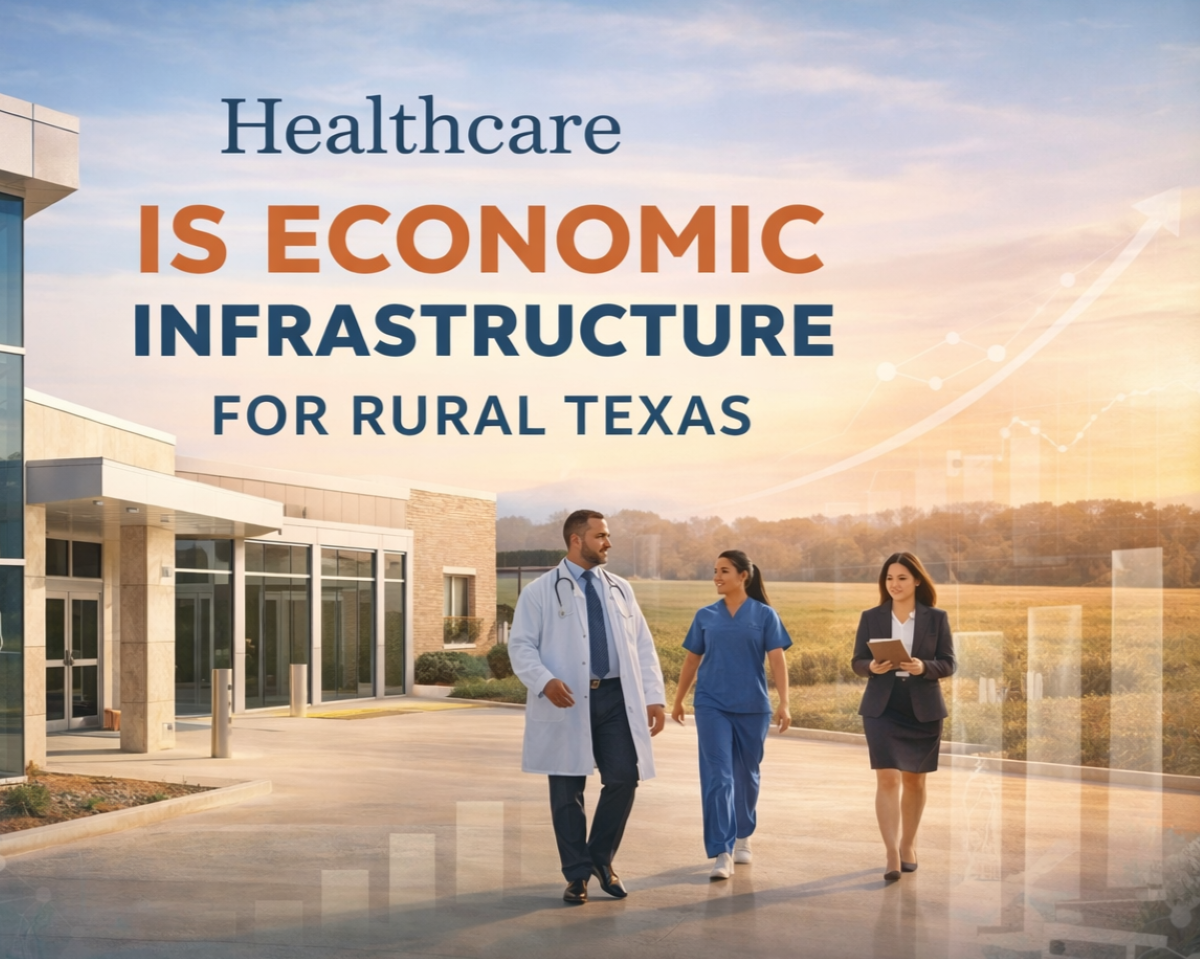
Healthcare is a Cornerstone of Anderson County’s Economy
10 Mar 2026
News
Healthcare is more than a basic service — it is foundational infrastructure that shapes a community’s economic stability and growth potential. As of 2025, more than 120 million Americans live in “healthcare deserts,” counties with limited access to primary care, emergency services, pharmacies, or affordable treatment options.
When people can’t easily access medical care, they are more likely to delay preventive appointments and miss opportunities for early intervention, resulting in poorer long-term health outcomes. Limited access also carries economic consequences, from lost wages due to long travel times to increased strain on local employers and families.
Anderson County, home of Palestine, Texas, is a rural service center for the region. It offers multiple healthcare services, including specialized care, supporting residents and the surrounding counties. From an economic development perspective, these healthcare facilities support talent retention and attraction, shaping the region’s future and bringing in new industries.
Beyond access to care, healthcare is a cornerstone industry in the East Texas regional economy. It is a major employer, providing career opportunities and competitive wages for residents across a range of skills and education levels. A closer look at Anderson County’s healthcare footprint reveals how the sector contributes not only to community well-being but also to long-term economic resilience.
Healthcare’s Economic Footprint in East Texas
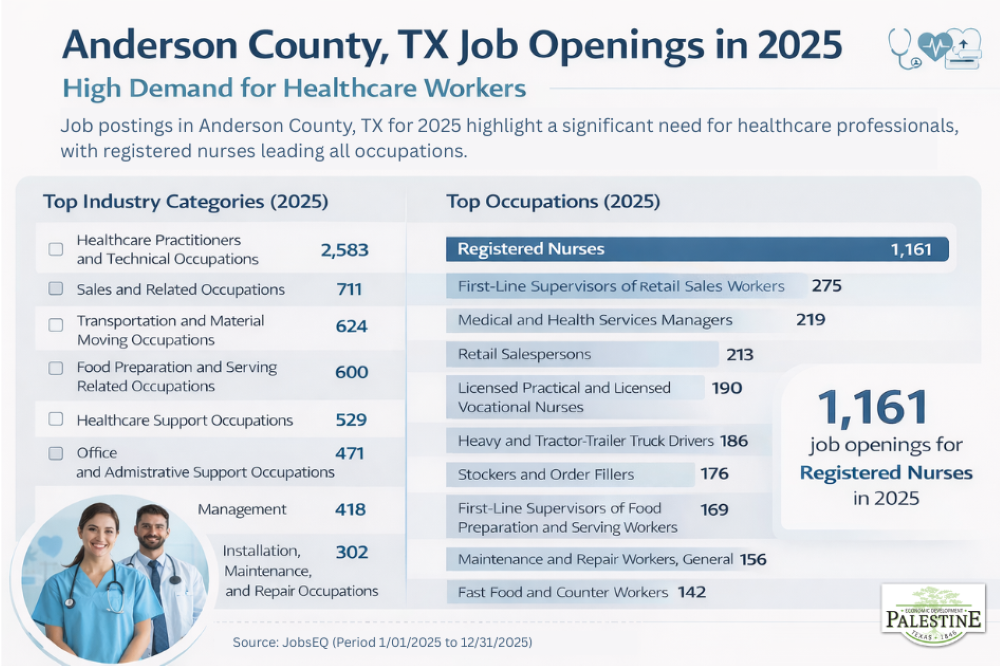
Healthcare facilities are among the largest employers in many communities, from regional hospitals to small private practices. In East Texas, healthcare and social assistance account for nearly 110,000 jobs, ranking among the region’s top industries as the second-biggest industry by far. However, this figure does not capture the full scope of healthcare employment. Publicly funded hospitals and related services are often classified within the Government sector, meaning the true healthcare footprint is even larger than reported under NAICS 62 alone.
Healthcare also offers higher average wages than many other industries. In Anderson County, several healthcare occupations — including registered nurses, physical therapists, and medical technicians — earn wages well above the county’s estimated living wage threshold. Registered nurses, for example, earn a median annual wage significantly higher than many service-sector occupations, reinforcing healthcare’s role in supporting middle-income career pathways. Healthcare careers are among the most diverse, offering a range of pathways from entry-level certifications to advanced clinical specialties and administrative leadership roles.
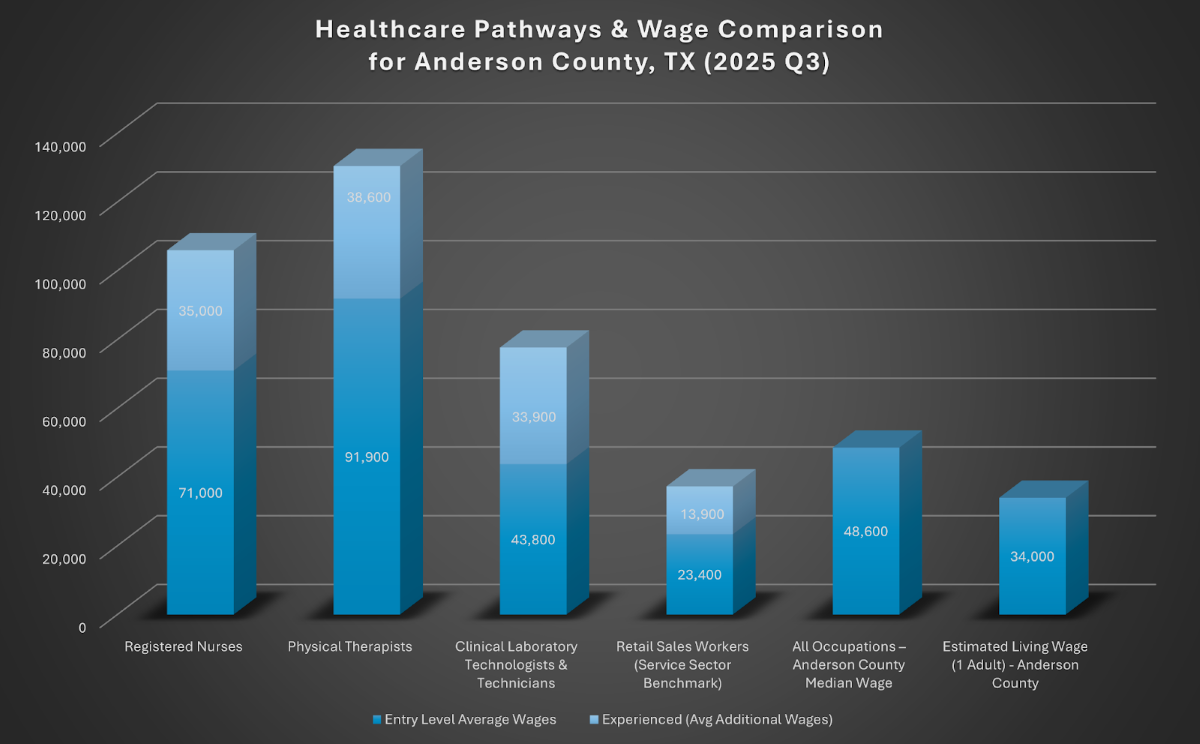
Healthcare also generates significant multiplier effects across East Texas. Hospitals and clinics hire local vendors, suppliers, construction firms, and service providers, expanding the sector’s economic impact beyond direct employment. Because demand for medical care remains relatively stable even during economic downturns, healthcare contributes to regional stability in ways many industries cannot.
Demand for Healthcare in Rural East Texas Continues to Grow
Workforce demand is one of the clearest indicators of healthcare’s continued expansion in rural East Texas. As East Texas grows, so does the demand for healthcare services. Over the past year, one in four (25%) of all job listings in the region were in the healthcare field – more than the next two largest industries combined. This sustained demand reflects both population growth and the essential nature of medical services in rural communities. In Anderson County, providers continue expanding services and capacity to meet evolving regional needs.
Texas is experiencing a notable demographic shift. In 76 of the state’s 254 counties, residents aged 65 and older now outnumber those under 18. While Anderson County maintains a comparatively balanced age profile, several neighboring counties skew older. As life expectancy increases, so does demand for senior-focused and chronic care services — trends that are shaping long-term planning efforts across the region.
At the same time, families across the region rely on consistent access to primary care, pediatric services, and preventative health resources. While Anderson County has access to maternity care, nearly half of the state's counties are maternity care deserts. Many rural healthcare systems are straining to balance the needs of both aging residents and younger families, requiring coordinated workforce development and facility planning.
Although Anderson County serves as a regional healthcare anchor, it remains designated as a Health Professional Shortage Area (HPSA) - a federal classification common in rural regions that reflects the wide geographic area local providers serve. Addressing workforce demand is an ongoing priority for healthcare systems, educators, and community partners. Recent investments in expanded medical facilities and emergency services demonstrate a continued commitment to meeting regional needs. As healthcare delivery evolves, collaboration among providers, training institutions, and economic development partners will be essential to sustaining long-term growth.
Palestine is Strengthening Its Healthcare Ecosystem
Healthcare growth in Palestine reflects both rising regional demand and sustained private-sector investment. Over the past year, the community has seen the opening of a new urgent care facility, the addition of a 15-bed emergency room and 10-bed microhospital, and the arrival of new medical practitioners. These expansions demonstrate confidence in the local market and a commitment to increasing access to care for residents across the region.
While these facilities were developed through independent healthcare providers, the Palestine Economic Development Corporation (PEDC) plays a complementary role by supporting workforce alignment efforts. PEDC has convened educators, employers, and regional partners to better understand healthcare workforce needs and strengthen local talent pipelines.
Most recently, stakeholders from across East Texas, including Palestine, participated in a regional workforce roundtable, Accelerating Healthcare Talent Pipelines in East Texas, focused on identifying staffing challenges and developing collaborative solutions. Together, these efforts reinforce a shared commitment to ensuring that healthcare capacity and workforce development grow alongside community needs. Healthcare expansion not only improves access to services but also strengthens the region’s overall economic competitiveness.
Healthcare Offers Strong Workforce Pathways in Anderson County
While healthcare demand continues to grow, so do opportunities for local workforce development. Analysis of recent healthcare job postings in the region shows that approximately 40% required fewer than three years of experience, with one in four requiring no prior experience at all. More than one-fifth required only a high school diploma or GED.
These data points underscore healthcare’s accessibility as a career pathway — not only for recent graduates, but also for residents seeking to upskill or transition into a new field. Combined with the competitive wages discussed earlier, healthcare offers stable, upwardly mobile career options within Anderson County.
PEDC supports this momentum by facilitating connections between healthcare employers, local independent school districts, and career and technical education (CTE) programs. By helping align classroom instruction with industry needs, these partnerships create clearer pathways from high school coursework to healthcare employment.
In addition, PEDC works with regional workforce partners to promote on-the-job training (OJT) opportunities, Workforce Innovation and Opportunity Act (WIOA) programs, and job shadowing experiences in the healthcare sector. These initiatives help residents gain practical experience while supporting employers in filling critical roles.
The shared goal is to create visible, attainable pathways into healthcare careers — whether through certifications earned while working, structured training programs, or early exposure through CTE coursework. When residents can envision a future in healthcare within their own community, workforce retention naturally strengthens.
Healthcare as a Strategic Economic Asset
Healthcare infrastructure plays a meaningful role in economic development strategy. Site selectors routinely evaluate access to hospitals, specialty care, and emergency services when assessing communities, as these assets influence workforce attraction, retention, and overall quality of life. Employers are more likely to invest in regions where residents have reliable access to essential services.
In that context, healthcare represents a competitive strength for Palestine and Anderson County. The county serves as a regional medical hub, and continued investments in facilities, services, and workforce alignment reinforce its role in supporting both residents and surrounding communities.
As healthcare demand evolves, collaboration among providers, educators, workforce partners, and economic development leaders will remain essential. By aligning infrastructure, talent pipelines, and community planning efforts, Anderson County can continue strengthening both healthcare access and long-term economic resilience.
Organizations interested in partnering on healthcare workforce initiatives are encouraged to connect with PEDC to explore collaborative opportunities.
More Topics